Advanced Econometrics & Data Science - 7.5 ECTS
Faculty
Professor Ralf A. Wilke - Department of Economics, CBS
Prerequisite
Estimation of and Inference for the multiple regression model (OLS, 2SLS, LPM, F-,t-,LR-,Wald-, LM-tests), Maximum Likelihood Estimation, Regression with Binary Dependent Variable, Matrix Algebra, Basic concepts of asymptotic theory (consistency and asymptotic normality). The course is compulsory for the PhD students of Copenhagen Business School’s Department of Economics but also open to other PhD students who have the equivalent knowledge in econometrics of an M.Sc. in Economics or Econometrics.
Duration
The course will run on 7 days in the Spring Semester 2027 with 6 hours per day. The first 6 days consist of 4 hours of lectures and 2 hours of computer sessions, which make 36 hours. The remaining 6 hours are reserved for student presentations on the last day of the course. In the case of more than 12 participants, an additional contact hour is added per every 2 additional participants to accommodate the additional presentations.
Aim of the Course and Learning Objectives
After the course, students shall be able to:
• demonstrate knowledge of the concepts, models, methods and tools of econometrics and data science as discussed during the course (when to apply what and why),
• read and understand international research papers that develop or employ econometric and data science methods in relation to the course,
• perform an econometric analysis including identification of the problem, formulation of the theoretical background, specification of a suitable statistical model, proper estimation of the model, and relevant hypothesis testing and inference,
• and to evaluate an empirical study conducted by another person/researcher that uses methods in relation to the course.
Course content
Designed for PhD students in Economics and related disciplines who want to deepen their understanding of econometrics & data science and widen their statistical methods repertoire for their thesis and later career. The material is useful for students doing empirical work, research on Econometrics or both. The course covers general econometric and data science methods, followed by micro-econometric models for mainly cross-sectional data.
Topics are illustrated in lectures by empirical examples. Stata and R sample code is made available such that participants can choose between these packages. Students will be offered the opportunity to deepen their understanding of the material with empirical computer exercises. The course is centered around rather general topics which of interest to a wider audience, rather than focusing on very specialised topics.
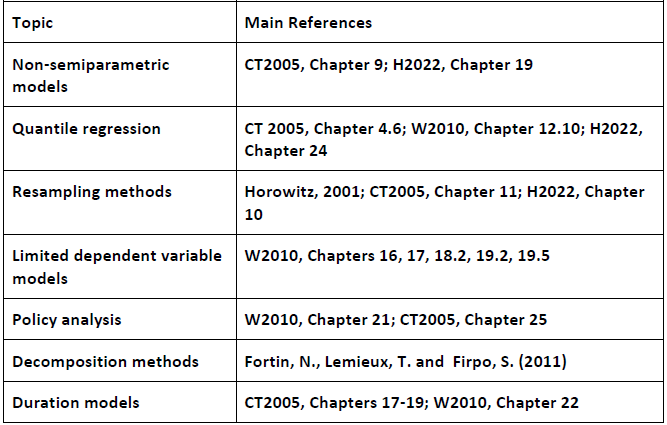
Topics covered by the course include:
General Econometrics & Data Science:
• Nonparametric Density and Regression, Semiparametric Regression
• Quantile Regression
• Resampling techniques
Cross Section Econometrics:
• Limited Dependent Variable models (Multiple Valued Discrete Responses, Continuous Dependent Variables)
• Policy Analysis (Regression Based, IPW, Matching, Synthetic Control)
• Decomposition Methods (Mean, Distribution)
• Duration Models (Single and Competing Risks)
A final list of topics will be given during the lectures.
Teaching methods
Face-to-Face teaching with the option to join online (hybrid). Zoom links will be available prior to course start via CBS’s virtual learning environment (Canvas).
Lectures and computer-based exercise classes. Students need to bring their own laptop.
Software: STATA licenses are available for CBS students. Students from other universities need to have their own license. R is open source.
Assessment
Extended essay (up to 10 pages) and student presentation (20 minutes+ 10 minutes discussion) on a topic related to the course content. The topic is chosen by the student and needs approval by the lecturer.