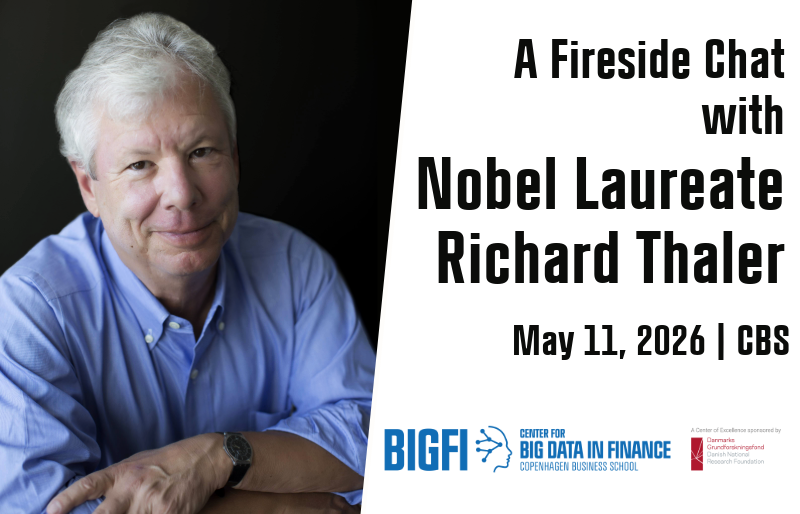
A Fireside Chat with Nobel Laureate Richard Thaler
Program
15:00-16:30: Fireside Chat
16:30-17: Reception
About the Fireside Chat
Why do people refuse to sell a losing stock? Can we nudge ourselves into making better decisions? And why did almost no economist see the financial crisis of 2008 coming? Over the course of his career, Richard Thaler answered these questions with behavioral economics, dragged the profession along with him, and won the Nobel Prize for his trouble.
Thaler’s guiding idea has been that economics can be improved by acknowledging that humans behave like humans. The first step was to convince the profession that people are not robots but, in fact, humans. In a series of pathbreaking papers in the 1980s and 1990s, Thaler persistently documented the patterns of real human behavior that economics could not explain, giving rise to his Anomalies series in the Journal of Economic Perspectives, which changed how economists think about markets and the people in them. Now, more than thirty years later, his new book The Winner’s Curse (with Alex Imas) revisits how well these anomalies have held up and takes stock of how far we have come in the behavioral revolution, and how far we have yet to go.
This is a rare chance to hear Thaler in person and to meet the economist who changed the field. His ideas, spread through books like Nudge (with Cass Sunstein) and Misbehaving, have reshaped retirement systems, public policy, and financial markets around the world. Whether you work in finance, policy, or academia, you will leave thinking differently about human behavior, and about your own.
About Richard Thaler
Richard H. Thaler is the Charles R. Walgreen Distinguished Service Professor of Behavioral Science and Economics at the University of Chicago Booth School of Business, where he directs the Center for Decision Research. He received the Nobel Memorial Prize in Economic Sciences in 2017 for his contributions to behavioral economics.
His new book, The Winner’s Curse: Behavioral Economics Anomalies, Then and Now, co-authored with Alex Imas of Chicago Booth, was named one of the Financial Times’ Best Books of 2025. Thaler is also the author of Nudge (with Cass Sunstein) and Misbehaving: The Making of Behavioral Economics, with millions of copies sold worldwide. He served as President of the American Economic Association in 2015 and is a member of the National Academy of Sciences and the American Academy of Arts and Sciences.
His research has directly influenced retirement savings design (through automatic enrollment and “Save More Tomorrow”), consumer financial regulation, tax enforcement, and organ donation policy in dozens of countries.
Organized by
The Center for Big Data in Finance (BIGFI) and the Department of Finance, Copenhagen Business School.
Moderator
Niels Joachim Gormsen, DNRF Chair Professor of Finance, Copenhagen Business School.